

16th December 2024
“lf women share their opinion on social media, they l should accept that they elicit sexist, demeaning and/or abusive replies” – more than half of surveyed Lithuanians agree with this statement, according to a new Eurobarometer public opinion survey. Experts argue that this reflects the normalization of a form of violence.
Cyber Violence Against Women is Widespread
In 2021, a study conducted by The Economist Intelligence Unit across 45 countries revealed that 85% of women surveyed had encountered violence in digital spaces. This issue disproportionately affects younger respondents. While Europe has the lowest prevalence of cyber violence globally, the rate is still alarmingly high at 74%. Furthermore, 62% of respondents said they feel helpless, as little is done to combat the issue.
A Eurobarometer survey found that 51% of Lithuanian respondents fully or partially agreed that women sharing opinions on social media should accept that they elicit sexist, demeaning and/or abusive replies. This figure is more than double the EU average of 21%.
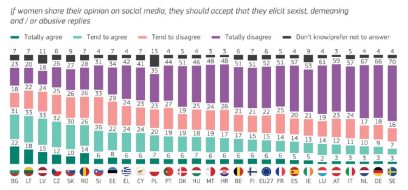
“The prevailing societal belief seems to be that if a woman speaks out on social media, it becomes an open invitation for cyber violence and bullying,” explains Seimas Ombudsperson Jolita Miliuvienė, who also temporarily serves as the Equal Opportunities Ombudsperson. “This mindset pressures women into self-censorship, with one in three opting not to share opinions online to avoid harassment. The consequences can be severe: cyber violence often escalates and spills into real-life scenarios.”
Justifying Leaking Intimate Photos
The survey also revealed that 70% of Lithuanian respondents believe that if women share intimate pictures of themselves with someone, they are at least partially responsible if the image is shared online without their consent.
Lithuania stands out within the EU on this issue, second only to Latvia in justifying such actions.
“These responses highlight the importance of the historic step taken in May this year with the adoption of the Directive on Combating Violence Against Women and Domestic Violence,” says J. Miliuvienė. “EU Member states, including Lithuania, must now incorporate this directive into national law. It criminalizes forms of cyber violence, including the unauthorized publication of intimate photos. This sends a clear message to women experiencing such violence: it is not their fault, and perpetrators can face real prison sentences.”
Cyber violence against women is gender-based violence that is perpetrated through electronic communication and the internet. Although cyber violence can affect both women and men, women and girls experience different and more traumatic forms of cyber violence, including ‘revenge porn’ and rape threats (EIGE).